Top Sellers
Top 50 Best Newest Supplements Top Protein Top Pre-Workout Top Post-Workout Top Fat Loss Top Intra-Workout Top Health & Wellness
Bodybuilding Books
Workout Accessories
Videos
Workout Music
Ads

 By: MuscleSports.net
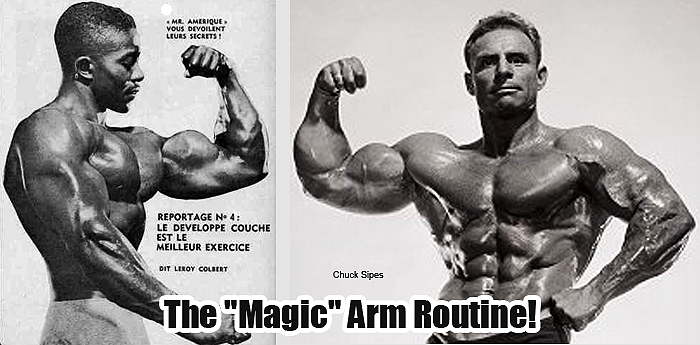
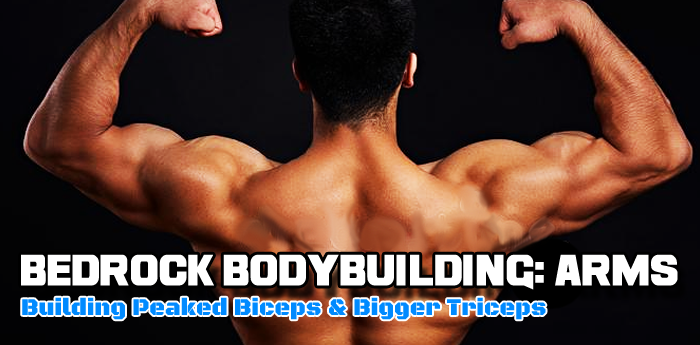
Let's cut the crap, gentlemen. You can have the widest back in the gym and a chest like a slab of granite, but when you're standing in the lobby or walking down the street, it's the arms that get noticed first. They're the billboard for your physique. They're the first thing people see, and they're the last thing people forget.
Now, I'm not telling you to neglect your legs or your back. But I am telling you that if your arms are lagging behind the rest of your physique—if they're the weak link in the chain—then it's time to specialize. It's time to declare war on those stubborn guns and bring them up to where they belong.
In the hallowed pages of Joe Weiders Muscle Builder (circa 1974), the philosophy was simple: mass comes first, refinement second. And when it comes to arms, the old-school masters knew something that too many modern lifters have forgotten—**the triceps are two-thirds of your upper arm, and building them is the fastest path to sleeve-stretching size.**
This is a specialization blueprint. A focused assault on lagging biceps and triceps, built on the anvil of old-school intensity and the furnace of modern sports science. We're going to give you the tools, the protocols, and the mindset to forge arms that command respect.
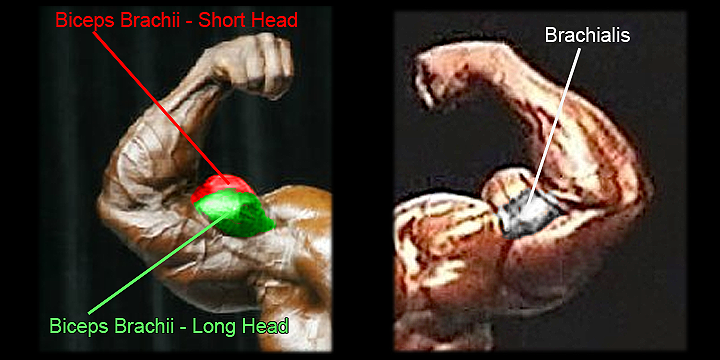
Before we can train these guns, we need to understand them. Modern sports science tells us that the upper arm is made up of two primary muscle groups: the biceps brachii (and its supporting cast) and the triceps brachii.
The biceps brachii is composed of two heads: the long (outer) head and the short (inner) head. But the biceps is not the only elbow flexor. The brachialis lies underneath the biceps and is a major contributor to arm thickness—pushing the biceps up and outward. The brachioradialis, which runs down the forearm, also assists in elbow flexion.
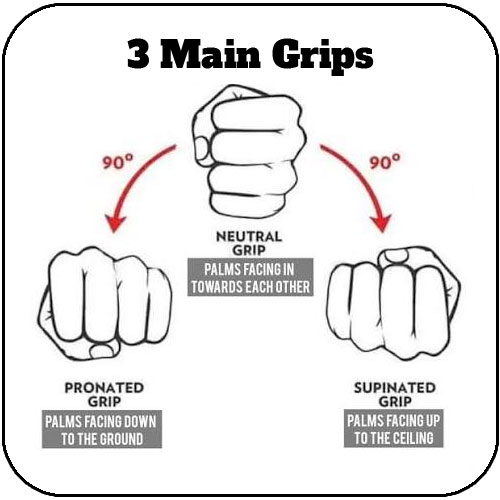
Here are your keys from the science: Grip Width and Hand Position determine which head gets the most stimulation. A wide grip (wider than your elbows) hits the short (inner) head, while a narrow grip emphasizes the long (outer) head. A supinated (palms-up) grip makes the biceps do most of the work, while a pronated (reverse) grip shifts the stress to the brachioradialis. A semi-supinated (hammer) grip is best for hitting the brachialis.
The triceps brachii is composed of three heads: the lateral (outer) head, the medial (inner) head, and the long head. The long head is particularly important because it also assists in shoulder extension and adduction—meaning overhead triceps extensions are crucial for fully stretching and developing this head.
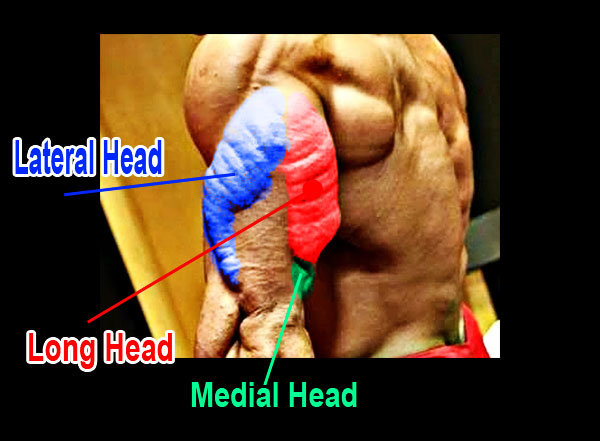
The science confirms that variations in elbow position and hand grip can shift the emphasis between these heads. An exercise done with elbows out stresses the lateral head, while hands farther apart than the elbows places more stress on the long and medial heads.
The off-season is where you build the mass. You're not to much worried about separation or detail yet. You're worried about volume and intensity. The science is clear: both high+-load and low-load training can produce significant hypertrophy when taken to failure. A study on 17 recreationally trained males found that muscle thickness increased significantly over nine weeks for both high-load (85% 1-RM) and low-load (30% 1-RM) groups, with no significant difference between them for most muscle groups.
The takeaway? - You need both heavy work for strength and density and higher-rep work for metabolic stress and pump.
**[IMAGE PLACEMENT: Small sidebar graphic—"The Off-Season Protocol" quick-reference box: 3 biceps exercises + 3 triceps exercises / 1 warm-up + 4 working sets / 8–12 reps / 2x per week]**Choose 3 exercises for biceps and 3 exercises for triceps per workout. Perform 1 warm-up set followed by 4 working sets of 8–12 reps, pyramiding up in weight each set. Train arms twice per week (e.g., Monday and Thursday).
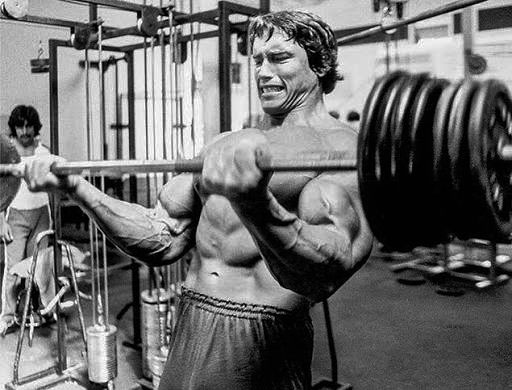
The bread and butter. No bullshit. Stand with feet shoulder-width apart, grip the bar at shoulder-width with a supinated (palms-up) grip. Keep your elbows pinned to your sides and curl the bar to your chest. Squeeze for a two-count at the top and lower under control. The science confirms that grip width matters: a narrow grip emphasizes the long (outer) head, while a wide grip hits the short (inner) head. Use a slow eccentric (negative) phase to maximize muscle damage and growth.
Protocol: 1 warm-up set of 12 reps, followed by 4 working sets of 8–12 reps, increasing weight each set.
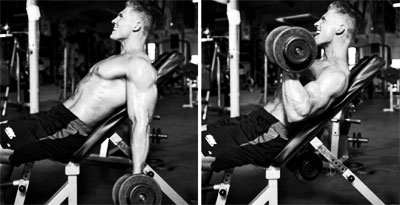
This one is about the stretch. Sit on an incline bench set to about 45 degrees. Let your arms hang down, fully extending the biceps. Curl both dumbbells simultaneously, supinating your wrists at the top. The deep stretch at the bottom is critical for long-head development.
Protocol: 1 warm-up set of 12 reps, followed by 4 working sets of 10–12 reps.
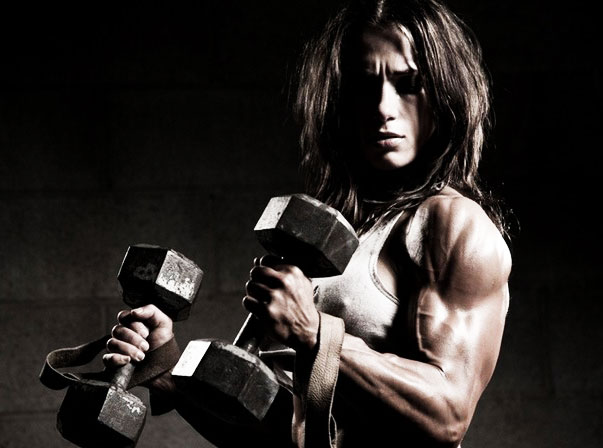
The brachialis builder. Grip the dumbbells with a neutral (hammer) grip. Keep your palms facing each other throughout the movement. This shifts the emphasis to the brachialis and the brachioradialis, pushing the biceps up and outward for that "peak" effect.
Protocol: 1 warm-up set of 12 reps, followed by 4 working sets of 10–12 reps.
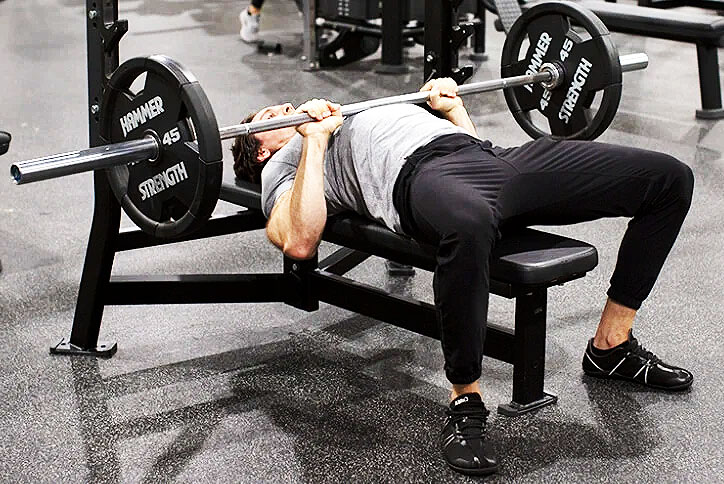
This is the king of triceps mass builders. Lie on a flat bench and grip the barbell with your hands about shoulder-width apart (or slightly narrower). Lower the bar to your chest, keeping your elbows tucked close to your body. Press it back up, squeezing your triceps at the top. The science confirms that elbows-in placement stresses the long and medial heads.
Protocol: 1 warm-up set of 10 reps, followed by 4 working sets of 8–10 reps, increasing weight each set.
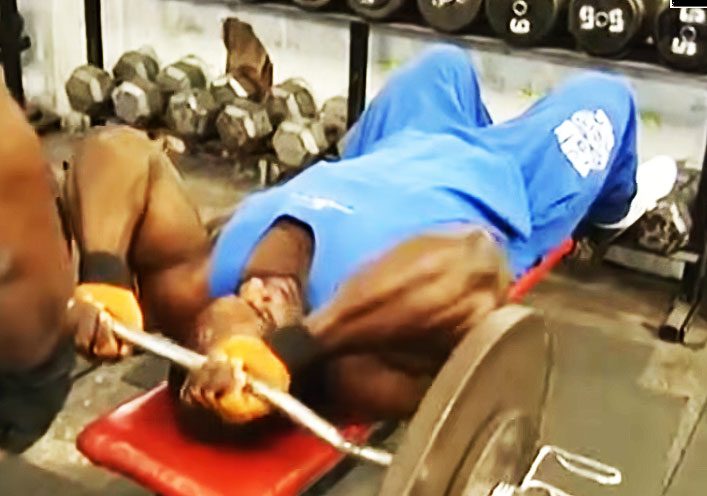
Lie on a flat bench and hold an EZ-bar with your arms extended straight up over your chest. Keeping your elbows pinned in place (they shouldn't move), lower the bar toward your forehead by bending at the elbows. Pause just before the bar touches your head, then extend back to the starting position. The EZ-bar is easier on the wrists than a straight bar.
Protocol: 1 warm-up set of 12 reps, followed by 4 working sets of 8–12 reps.
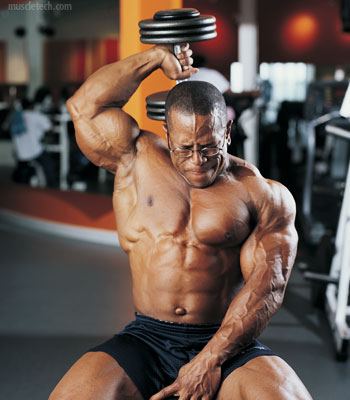
This is the long-head specialist. The long head of the triceps crosses the shoulder joint, meaning it is fully stretched when your arms are overhead. Stand or sit, hold a dumbbell with both hands overhead, and lower it behind your head. Extend back to the starting position.
Protocol: 1 warm-up set of 12 reps, followed by 4 working sets of 10–12 reps.
Now we enter the contest prep phase. This is where we turn the foundation into a work of art. The heavy weights are (mostly) put away. Now it's about **control, detail, and carving the crevices** that make champions.
**[IMAGE PLACEMENT: Small sidebar graphic—"The On-Season Protocol" quick-reference box: 4 biceps exercises + 4 triceps exercises / 4 sets / 12–15 reps / controlled tempo]**Pick 4 exercises for biceps and 4 exercises for triceps and perform 4 sets of 12–15 reps. The weight will increase, but never at the expense of form.
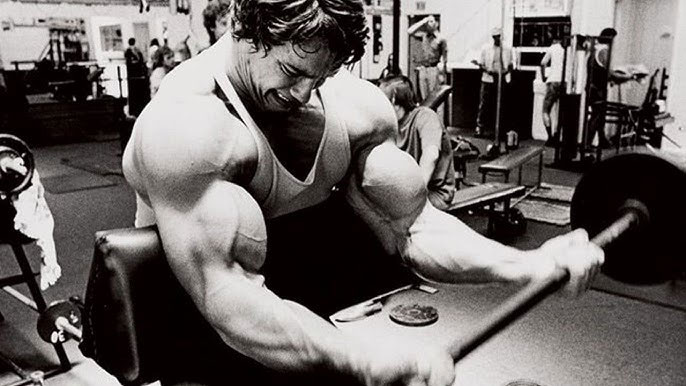
Larry Scott, the first Mr. Olympia, swore by these, and they're still the gold standard for building the biceps peak. The preacher bench isolates the biceps and prevents cheating. Use a straight or EZ-bar and curl the weight up slowly, squeezing at the top. Larry Scott performed up to 6 sets of 6 reps, but we're using 12–15 reps for the on-season to maximize blood flow and detail.
Protocol: 1 warm-up set of 12 reps, followed by 4 working sets of 12–15 reps.
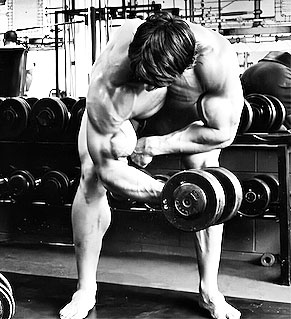
Sit on a bench and lean forward slightly. Rest your right elbow against your inner right thigh. Curl the dumbbell up toward your shoulder, squeezing the biceps hard at the top. Perform all reps for one arm before switching to the other. This is the ultimate isolation movement for the biceps.
Protocol: 1 warm-up set of 12 reps, followed by 4 working sets of 12–15 reps per arm.
Grip the barbell with a pronated (overhand) grip. This shifts the emphasis to the brachialis and brachioradialis, adding thickness to the upper arm and improving the overall look. Larry Scott included these in his routine for a reason.
Protocol: 1 warm-up set of 12 reps, followed by 4 working sets of 12–15 reps.
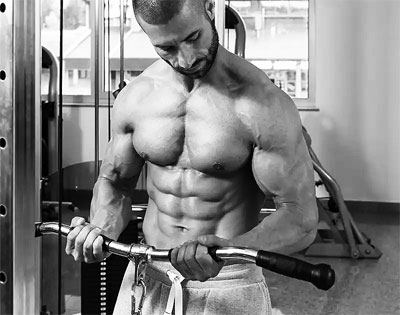
This is an old-school intensity technique used by the likes of Larry Scott and Arnold Schwarzenegger. Use a cable machine with a straight bar and perform the "21s" protocol: 7 reps from the bottom to the midpoint, 7 reps from the midpoint to the top, and 7 full-range reps. The constant tension from the cable keeps the biceps under load throughout the entire range of motion.
Protocol: Perform 3 sets of 21 reps, resting 60–90 seconds between sets.
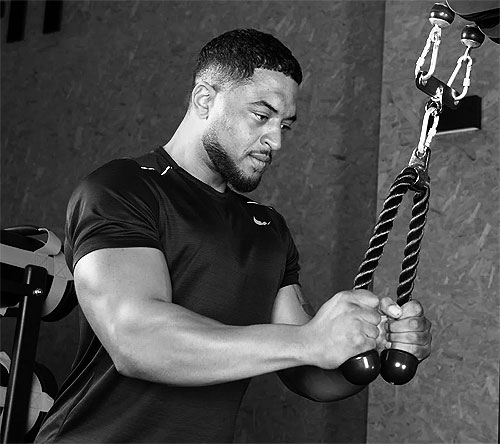
This is the detail-carver. Attach a rope to the cable machine and push down, spreading the rope at the bottom to fully contract the triceps. The rope allows for a greater range of motion and more emphasis on the lateral head. Perform with a slow eccentric and a squeeze at the bottom.
Protocol: 1 warm-up set of 12 reps, followed by 4 working sets of 12–15 reps.
Bend forward at the waist, supporting yourself with one hand on a bench. Hold a dumbbell in the other hand, with your upper arm parallel to the floor. Extend your arm backward, squeezing the triceps at the top. This movement isolates the lateral head and is perfect for carving detail. Larry Scott used this as a finisher.
Protocol: 1 warm-up set of 12 reps, followed by 4 working sets of 12–15 reps per arm.
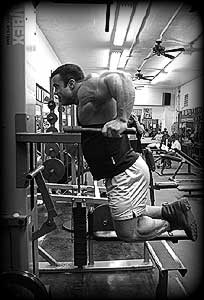 Dips are the squat of the upper body. When performed with a forward lean, they target the chest; when performed upright, they hammer the triceps. Lower yourself until your knuckles almost touch your armpits, feeling the deep stretch in the triceps. Push yourself back up, but **do not lock out**—keep constant tension on the triceps.
Protocol: 1 warm-up set of 10 reps, followed by 4 working sets of 12–15 reps (add weight if needed).
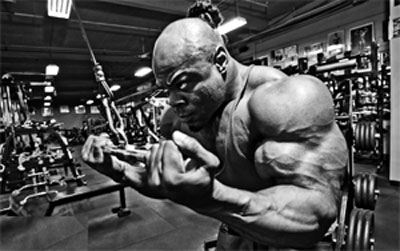
This is a variation that most lifters ignore, and it's a mistake. Grip the straight bar with a supinated (palms-up) grip. Push down, focusing on squeezing the triceps at the bottom. This emphasizes the **long head** of the triceps.
Protocol: 1 warm-up set of 12 reps, followed by 4 working sets of 12–15 reps.
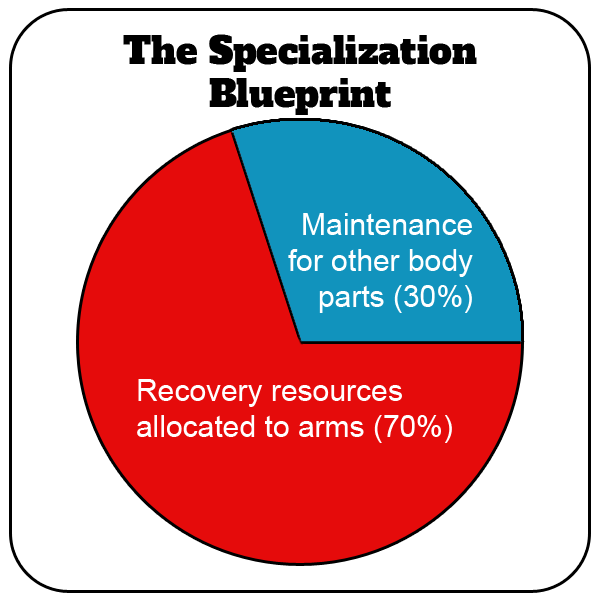
Now, why does this work? Modern sports science tells us that specialization is the key to bringing up lagging body parts.
Your body has a limited capacity for recovery. Dr. Mike Israetel of RP Strength explains that while each muscle group has its own Maximum Recoverable Volume (MRV), your total systemic recovery is limited. You can't train every muscle at its maximum volume and expect to grow.
The solution - Short-term specialization. Instead of blasting every muscle group, you keep most of your body at maintenance volume — just 4 hard sets per muscle per week can keep most muscles from shrinking, especially in a calorie surplus—and direct all your recovery resources into your arms.
For most lifters, three arm-focused workouts per week is ideal for growth without overtraining the joints. Here's the blueprint:
 Monday: Arms (Focused)
 Tuesday: Chest, Back, Shoulders, Legs (Maintenance) Wednesday: Arms (Focused) Thursday: Chest, Back, Legs, Shoulders (Maintenance) Friday: Arms (Focused)
 Saturday/Sunday: Recovery
This allows you to hit your arms hard three times per week while keeping your full body stimulated and maintained. The science backs this up; studies on high-frequency training show significant increases in muscle thickness when volume is optimized.
Always finish with a deload week to allow for recovery and adaptation.
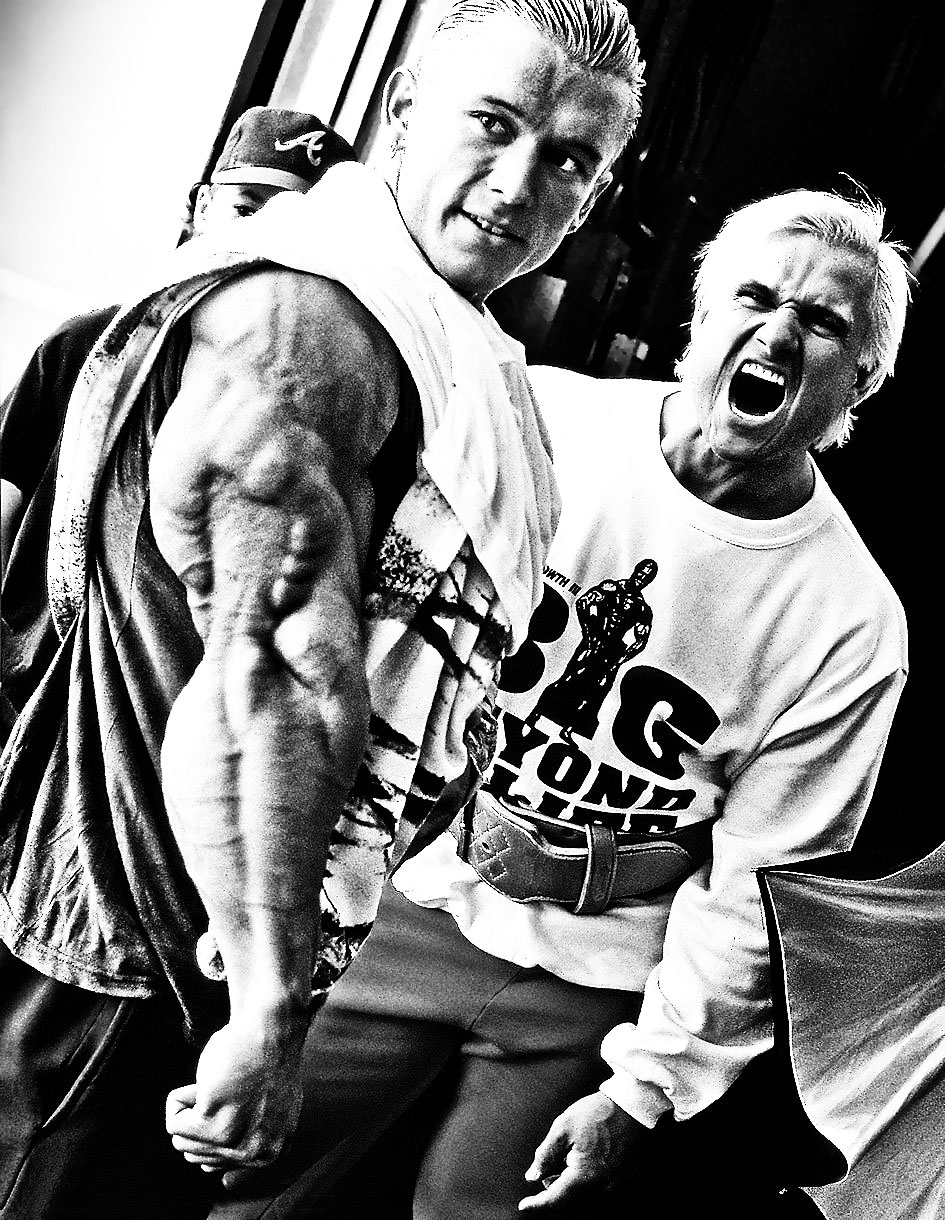
Lee Priest, the Australian bodybuilding legend who built some of the most iconic arms in the history of the sport, was adamant about this. "If you want bigger arms, you need to train the triceps" – Priest has said. The triceps make up two-thirds of your upper arm, yet most lifters spend 75% of their arm training time on biceps. This is a cardinal sin. The triceps are the key to sleeve-stretching size.
Lee Priest also emphasized the importance of having a dedicated arm day. "I just do arms by themselves, I wouldn't do a heavy triceps workout the day before you got to do chest or shoulders because then a lot of your push power is going to be gone, or I wouldn't go have a massive biceps workout the day before back, so I do the major big body parts first, then do arms later."
The science is unequivocal: the **eccentric (lowering) phase** is crucial for hypertrophy. Controlled negatives maximize muscle damage and repair. Every rep should have a 3–4 second negative. If you're swinging the weight, you're cheating yourself.
Full ROM ensures that all areas of the muscle are stimulated. A study on vertical pulling (like chins and pulldowns) found that full range of motion activates the lower lats more than partial movements. The same principle applies to curls and extensions. Don't cut the movement short.
This isn't optional. As Arnold famously said in *Muscle & Fitness*, "it takes about a 10-pound weight gain to add 1 inch in arm size." To gain weight, you need to eat more often (up to six meals a day) and increase your calorie intake by at least 1,500–2,000 calories a day. Without a calorie surplus, you're not building mass.
This is the path. The path to arms that command respect. You must earn the right to "sculpt" by first building the clay. The modern lifter spends too much time on ego lifts and not enough time on controlled, high-volume specialization.
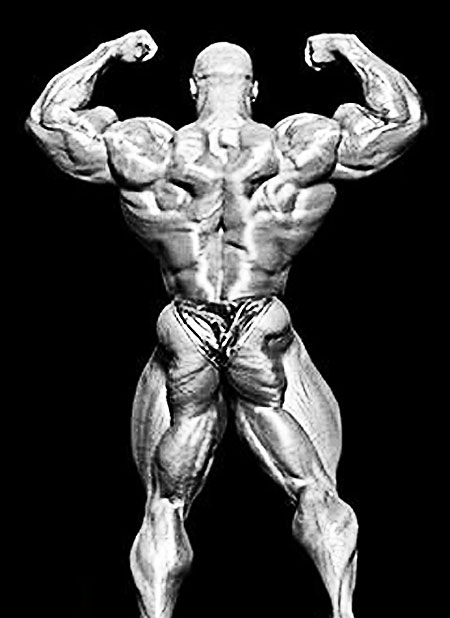
Get OFF your ASS, grab the iron, and build arms that people will remember. Because when you hit that double front bicep pose, you don't want them to see a collection of lumps; you want them to see the foundation of a champion.
Train hard. Eat harder.
Additional Historical & Contextual References (Non-Peer Reviewed)
Tags: workout programs arms

Thank You...

Send Us Your Comments:
ARMS SPECIALIZATION: Bringing Up Lagging Biceps & Triceps - Comments
Sponsored Products:
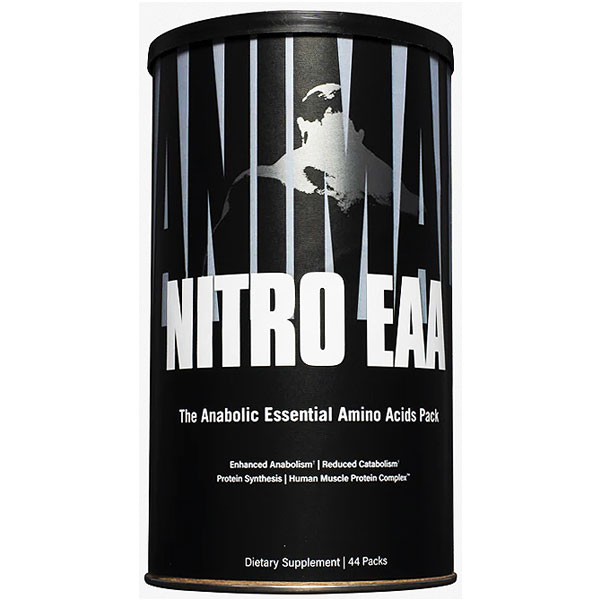
ANIMAL
NITRO
Accelerated Amino Transport!
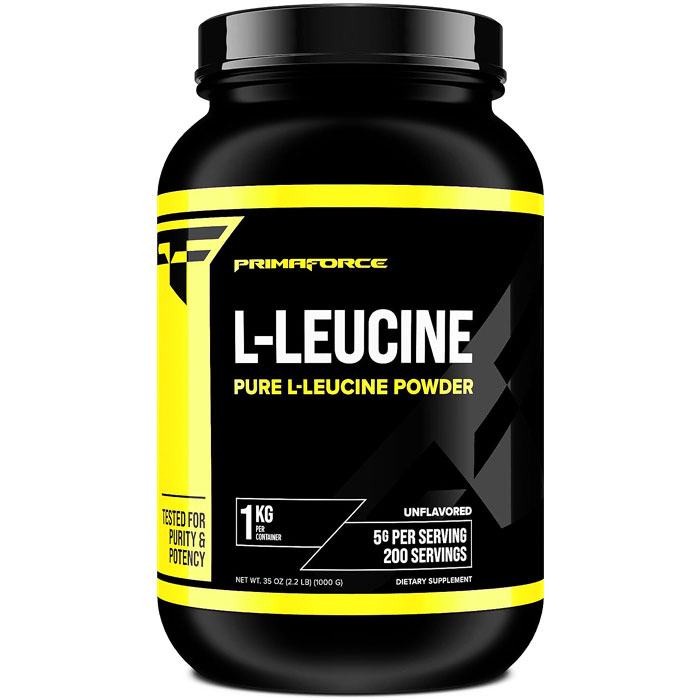
PRIMAFORCE
L-Leucine
Enhance Recovery

Novex Biotech
Oxydrene
NAD+ Enhancer

Optimum Nutrition
Platinum Rebuild
Post-Workout Protein
Comments:

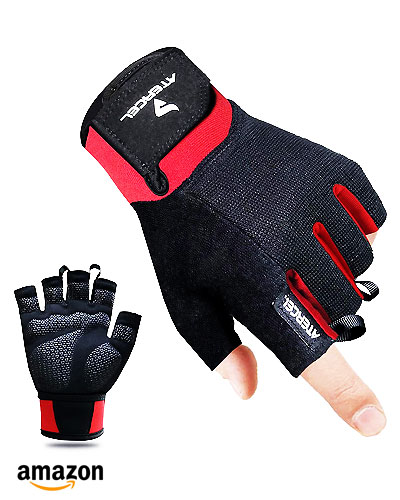
ATERCEL
Workout Gloves for Men and Women
Breathable and Snug fit - Exercise Gloves for Weight Lifting, Cycling, Gym, Interval Training!
Price: $14.95 Get Yours
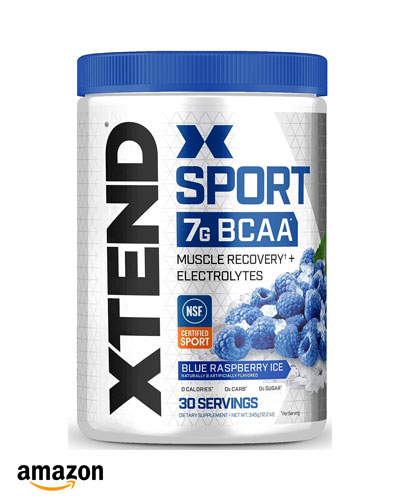
XTEND
Sport BCAA
Electrolyte Powder for Recovery & Hydration with Amino Acids!
Price: $21.99 Get Yours