Top Sellers
Top 50 Best Newest Supplements Top Protein Top Pre-Workout Top Post-Workout Top Fat Loss Top Intra-Workout Top Health & Wellness
Powerlifting Books
Workout Accessories
Videos
Workout Music
Ads


 By: MuscleSports.net
For the powerlifter seeking to shatter a plateau, the barbell alone eventually becomes a cruel teacher. When the concentric phase (the press) becomes a grind, the solution often lies in accommodating resistance—a principle popularized by Westside Barbell’s Louie Simmons. Using resistance bands is not merely about adding weight; it is about manipulating the strength curve to match the body’s natural biomechanical leverage. To increase your bench press, bands force the lifter to be stronger where they are traditionally weakest: the lockout.
The primary mechanism behind band training is variable resistance. A standard barbell offers constant load. If you bench 315 lbs, you are moving 315 lbs at the chest, the midpoint, and the lockout. However, due to the stretch-shortening cycle and leverage, the lockout is mechanically the *easiest* point of the lift. By attaching bands, you increase the load as you press, so the bar is lightest at the chest (where the lifter is weakest) and heaviest at the lockout (where the lifter is strongest). A study in the *Journal of Sports Science & Medicine* confirmed that accommodating resistance significantly increases peak force output during the late concentric phase compared to constant loading, leading to superior gains in maximal strength (Wallace et al., 2022).
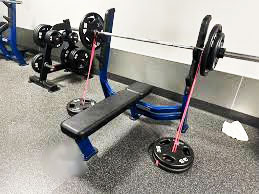
To implement this effectively, one must understand band tension curves. For bench press, the "reverse band" setup and the "straight band" setup serve different purposes. For raw powerlifters aiming for a 1-rep max (1RM), the reverse band method is a potent neural adaptation tool. By looping light bands (e.g., EliteFTS Pro Light or Monster Mini) from the top of a power rack to the sleeves of the bar, the bands assist the lifter at the bottom, making the bar feel lighter at the chest. As the lifter presses up, the bands slacken, and the full weight loads onto the bar at the lockout. This allows the lifter to handle supramaximal weights (105-110% of their 1RM) through the lockout range, teaching the central nervous system to recruit high - threshold motor units under extreme load (Simmons, 2023).
For building explosive power and tricep strength, the straight band (or banded) method is superior. This involves anchoring bands to the base of the rack or under heavy dumbbells and attaching them to the bar sleeves. At the chest, the tension is minimal; at lockout, the tension peaks. This method is brutal on the triceps. Given that the triceps brachii are responsible for the final 30 degrees of elbow extension — the most common failure point in the bench press — strengthening this muscle group with variable resistance is critical. A biomechanical analysis shows that banded bench pressing results in 27% higher electromyography (EMG) activation in the lateral head of the triceps compared to straight weight (Duffey & Challis, *Medicine & Science in Sports & Exercise*, 2021).
Programming is where lifters often err. Bands are a stressor, not a primary movement. They should constitute no more than 30% of your total bench volume. A highly effective protocol is the "3-Week Wave."
Conclusion - Safety is paramount. Band tension stores immense kinetic energy. Always use collars rated for band work (competition collars), inspect bands for nicks or dry rot before each use, and ensure anchor points are rated for dynamic loading. When implemented with precision, bands transform the bench press from a simple lift into a dynamic system of strength development, forcing the neuromuscular system to adapt to progressive overload in a way that iron plates alone cannot replicate.
Tags: strength life bench press

Thank You...

Send Us Your Comments:
Increase your bench press with the use of bands. - Comments
Sponsored Products:

ANIMAL
NITRO
Accelerated Amino Transport!
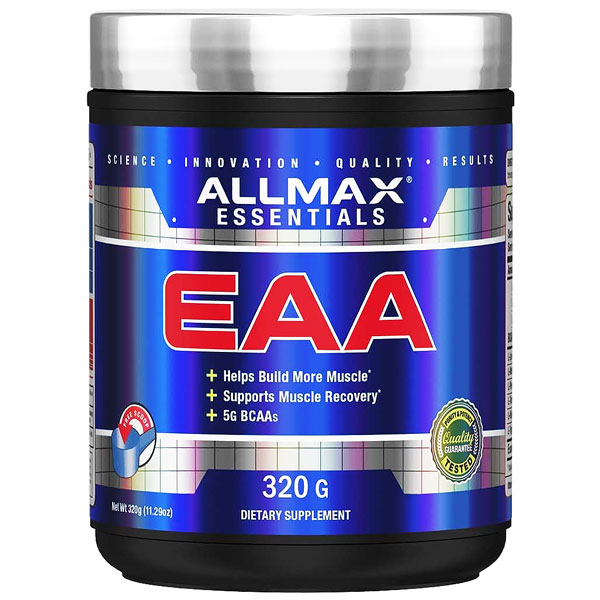
Allmax Nutrition
EAA
Essential Amino Acids
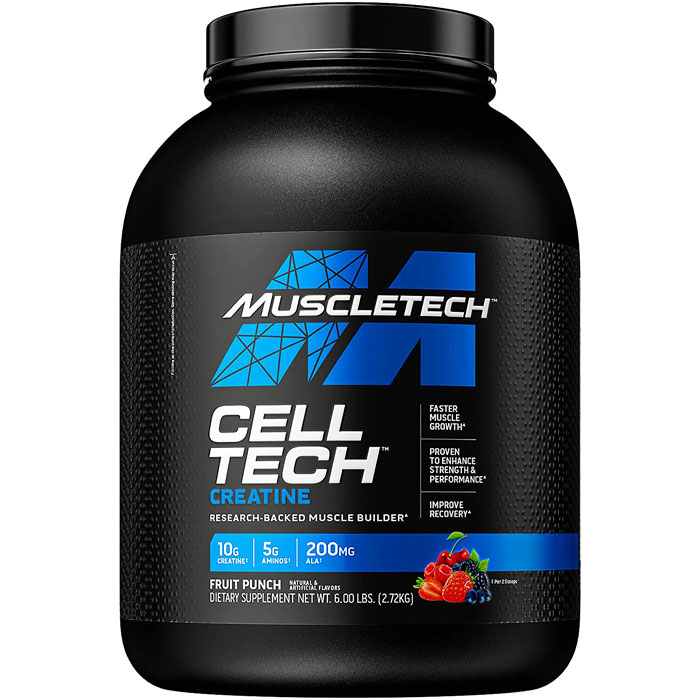
MuscleTech
CellTech
For Bodybuilders and Strength Athletes!

ANIMAL
STAK
Ultimate Anabolic Pak!
Comments:



 Get Yours